
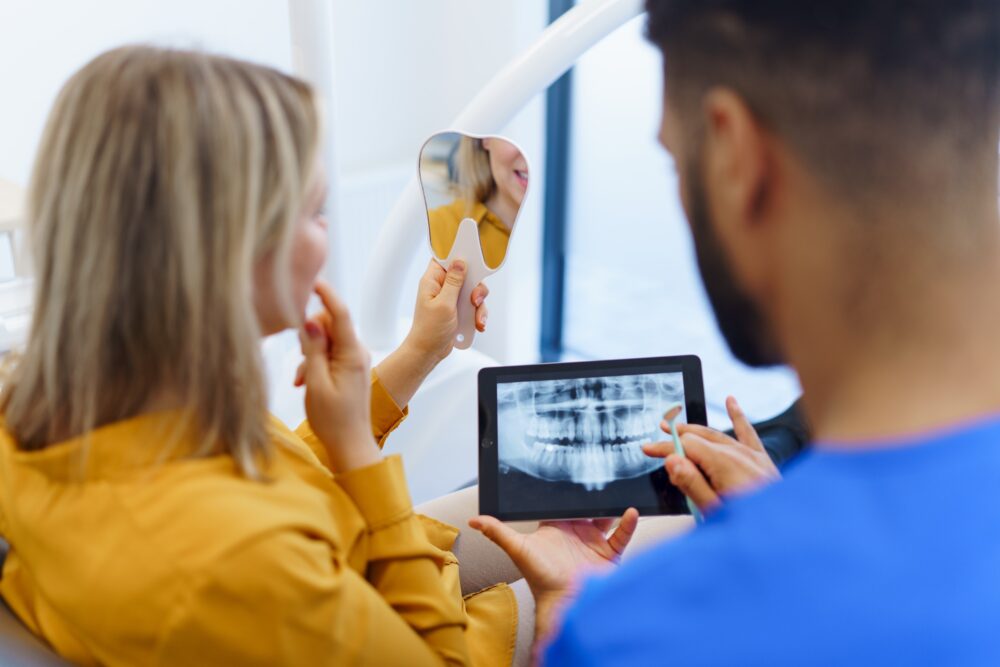
Missing teeth change more than your smile. They affect how you chew, how you speak, and how confident you feel around other people. They also affect the health of the rest of your mouth. When a tooth is lost, the jawbone in that area starts to shrink and nearby teeth can shift out of position.
Dental implants are often the strongest, longest-lasting way to replace missing teeth. They are not the only option, and they are not right for everyone. You need clear information, not sales pressure.
Use the questions below to decide whether dental implants in Highlands Ranch make sense for your situation and what to discuss during a consultation.
What Exactly Is a Dental Implant?
A dental implant is not the visible tooth you see in your smile. It is a small, biocompatible post (usually titanium) that is placed into the jawbone where the tooth root used to be. Over time, the bone fuses with the implant in a process called osseointegration.
On top of this implant, your dentist places:
- A connector piece (abutment)
- A custom crown, bridge, or denture
The result is a replacement that looks, feels, and functions much like a natural tooth. For a deeper overview of how this works, review Twiss Dental’s page on dental implant services.
Why Choose Implants Over Bridges or Dentures?
Dental bridges and removable dentures remain useful treatments, but they have trade-offs.
Bridges
- Require reshaping the healthy teeth on either side of the gap
- Do not replace the missing tooth root, so jawbone in that area still shrinks over time
- Can be harder to keep perfectly clean under the bridge area
Removable dentures
- Can move or slip while talking or eating
- May feel bulky on the gums
- Accelerate bone loss under the denture because pressure is applied to the gums instead of the bone
Implants
- Replace both the visible tooth and the missing root
- Stimulate the jawbone and help slow or prevent bone loss
- Do not rely on neighboring teeth for support
- Provide strong, stable chewing function
If you want more detail on the long-term impact of implants versus other options, read Twiss Dental’s article on the life-changing benefits of dental implants.
Am I a Good Candidate for Dental Implants?
Implants require certain conditions to succeed. A proper evaluation looks beyond just the gap in your smile.
You are more likely to be a good candidate if:
- Your gums are healthy or can be made healthy with treatment
- You have enough jawbone to support the implant (or are a candidate for bone grafting)
- You do not smoke or are willing to stop during healing
- You manage medical conditions like diabetes under the guidance of your physician
- You are committed to excellent daily oral hygiene and regular checkups
You may still qualify even if you have some risk factors. The key is honest assessment and planning, not forcing implants into every case.
How Long Do Dental Implants Last?
Implants are designed as a long-term solution. With proper care, many implants last decades, and some last a lifetime. The crown, bridge, or denture attached to the implant may need periodic replacement due to normal wear, but the implant itself can remain stable if the surrounding bone and gums stay healthy.
Longevity depends heavily on:
- Gum and bone health (no active periodontal disease)
- Consistent daily home care (brushing, flossing, cleaning around the implant)
- Regular professional maintenance appointments
- Avoiding habits like smoking or using teeth to open packages
If you want quick facts to share with family or compare options, Twiss Dental’s blog on 4 key facts about dental implants is a simple summary.
What Does the Implant Process Actually Involve?
Many people imagine implant treatment as a single, dramatic surgery. In reality, it is a series of controlled, carefully planned steps.
Typical sequence:
- Consultation and planning
Clinical exam, X-rays, and often 3D imaging are used to evaluate bone volume, gum health, and bite alignment. A personalized treatment plan is created. - Preparatory procedures (if needed)
This might include extractions, bone grafting, gum treatment, or temporary restorations to keep your smile functional while you heal. - Implant placement
The implant post is placed into the jawbone under local anesthesia (and sedation if appropriate). A temporary tooth may be placed, depending on the situation. - Healing and integration
Over several weeks to months, the bone fuses with the implant. During this time you follow specific hygiene and diet instructions. - Abutment and final restoration
Once healed, a connector (abutment) and custom crown, bridge, or denture are attached. Your bite is adjusted for comfort and function.
The number of visits depends on how many implants you need, whether bone grafting is required, and your healing response.
How Do Dental Implants Affect Everyday Life?
Once healed, well-placed implants should feel routine, not dramatic. Most patients report:
- Eating feels more natural and comfortable
- Confidence improves when talking, laughing, and smiling
- No need for adhesives or worrying about dentures shifting
- Easier cleaning compared with some bridge or partial denture designs
You still need to treat implants like natural teeth: brush, floss, clean around them carefully, and maintain regular professional care. Neglect leads to peri-implant disease, a condition similar to gum disease around natural teeth.
What Are the Risks of Dental Implants?
Any surgical procedure carries risks. With proper planning and a qualified provider, serious complications are rare, but you should still understand the possibilities.
Potential risks:
- Infection at the implant site
- Poor integration with the bone (“implant failure”)
- Nerve irritation or sinus complications in certain areas
- Breakage of an implant component under extreme forces
- Peri-implantitis (inflammation and bone loss around the implant)
Most issues can be minimized with:
- Thorough planning and imaging
- Good surgical technique
- Realistic expectations about healing time and home care
- Honest discussion of your medical history and medications
If your overall dental condition includes worn teeth, old restorations, or missing teeth in several areas, implants may be just one part of a broader restorative dentistry plan instead of a standalone treatment.
How Much Do Dental Implants Cost Compared to Other Options?
Up front, implants usually cost more than bridges or dentures. Over time, they can become more cost-effective because they:
- Do not require support from neighboring teeth, reducing the risk of future treatment on those teeth
- Help preserve bone, which may reduce the need for future grafting
- Often last significantly longer than many fixed or removable alternatives
Total cost depends on:
- How many implants you need
- Whether you need bone grafting or sinus lifts
- The type of restoration on top (single crown, bridge, full arch)
- Laboratory and material choices
Avoid shortcuts. Lowest price rarely means best value with implants. Proper planning, quality materials, and experienced technique matter more than saving a few dollars up front.
When to Consider an Implant Consultation in Highlands Ranch
You should seriously consider a dental implant consultation if:
- You are missing one or more teeth
- You wear a partial or full denture and dislike the fit or stability
- A tooth has been recommended for extraction and you want to plan the replacement
- You have been postponing treatment and want a long-term solution, not constant patchwork
Dental implants are not the answer for everyone, but they are often the closest modern dentistry can come to giving you back a strong, stable, natural-looking tooth. A focused consultation at Twiss Dental in Highlands Ranch will provide imaging, options, timelines, and clear expectations so you can decide whether implants fit your health, budget, and long-term goals.